
A compass for complexity: The case for measurement-based care in youth mental health
We track our steps, our sleep, and our macros — but are we tracking the thing that matters most?

Look around any workplace and you’ll spot them: a smart watch here, an Oura ring there. People are monitoring their sleep cycles, stress levels, heart rate variability, and just about any other health metric they can get their hands on. The quantified self is moving into the mainstream, and its being taken up at scale by the health and wellness industry.
In many ways, this is a good thing. The rise of run clubs, cold plunges, and biometric tracking reflects a growing public appetite for proactive health management. We are, slowly, becoming a nation that values prevention over cure.
But here’s the uncomfortable irony: while we obsess over optimising our physical performance and health, our approach to mental health care remains largely static, reactive, and stubbornly analogue.
In a recently published piece for Nature Mental Health, I make an urgent case for how we can change this for mental health. The piece tackles why digital measurement-based care needs to become common practice and become a foundation for how we deliver quality mental health care in Australia and elsewhere.

A prediction problem
While sitting at an airport in Vancouver last year, my coauthor (Professor Ian hickie) and I were chatting about the complexities of youth mental health and what this means. Having just watched (and read) the three body problem, I couldn’t help but use it as an analogy. Predicting the orbit of two planets around each other is straightforward. Newton’s laws handle it cleanly. But add a third body and the maths breaks down entirely. Interactions become chaotic. Trajectories become unpredictable.
This felt like a way to describe the challenges we seem to face in youth mental health. The interplay of a person’s biology, psychology, behaviour and social environment creates a system (or systems within systems) that is genuinely complex and hard to forecast. Most serious disorders begin in adolescence, but early signs are often nonspecific. The same diagnosis can lead in wildly different directions. Despite our best efforts, psychiatry currently cannot reliably predict who will deteriorate, who will recover, and who will relapse.
But this does not mean we are helpless. There is a practice that can navigate it, and that is measurement-based care. We just aren’t using it nearly enough.
What is Measurement-Based Care (MBC)?
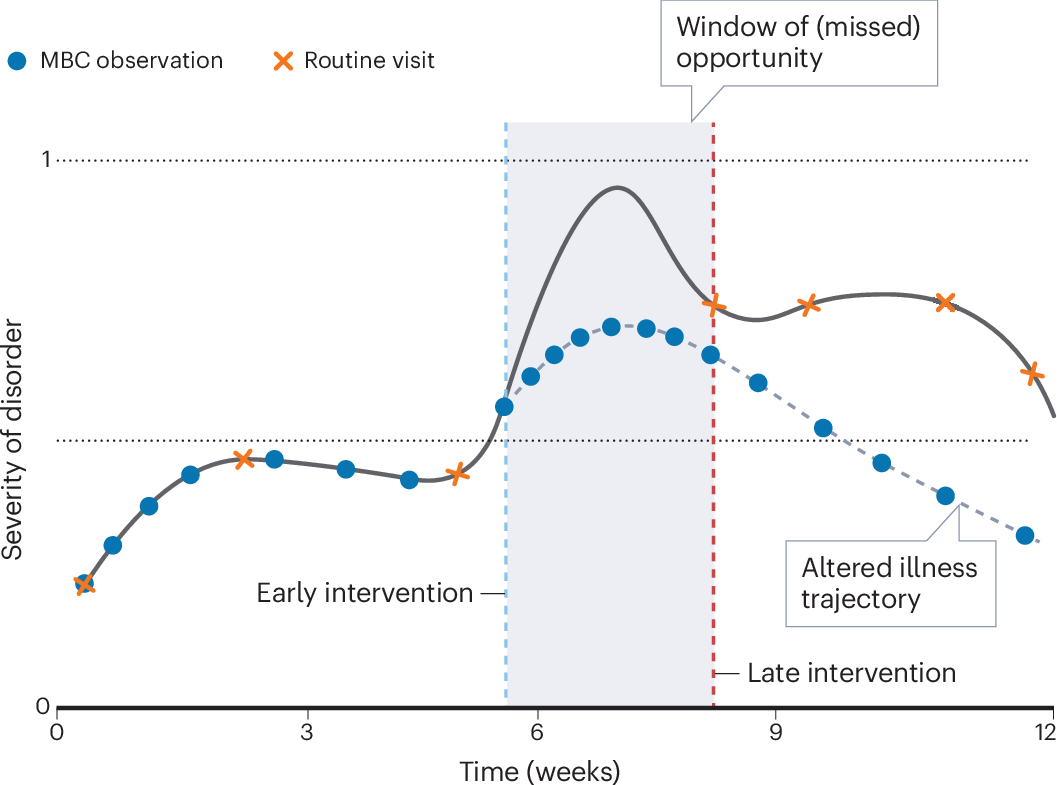
At its core, MBC means routinely collecting standardised data (symptoms, functioning, mood, sleep) and using those metrics to actively guide treatment decisions. I think of it as a compass: one that helps clinicians and consumers navigate together, adjusting course in real time rather than waiting for a crisis to force a change in direction.
The current system, by contrast, relies on appointments spaced weeks apart. By the time a pattern becomes visible, the window to intervene early has often passed leading to more costly and intensive interventions. The broader evidence consistently shows that it is effective for improving illness outcomes. Frequent monitoring captures what happens between appointments and that is precisely where the opportunity to change someone’s trajectory lives.
This is the core promise of MBC: it moves mental health care from reactive to proactive, and from generic to personalised.
What digital technology is now making possible
When I started working in this space, MBC largely meant paper-based symptom questionnaires completed in waiting rooms. But digital technology has fundamentally changed what is now possible, and I am excited for where this field is going with new innovations.
Ecological momentary assessment — sampling a person’s mood, thoughts or behaviour daily or multiple time per day in real-world settings gives us a far richer picture of someone’s mental state than a weekly questionnaire ever could.
Digital phenotyping goes further, using passive data from smartphones, movement patterns, sleep, social media activity, communication frequency, to continuously monitor signals that correlate with mental health states, without requiring the person to actively report anything.
Together, these approaches make possible what we call just-in-time adaptive interventions: support delivered at precisely the moment it is most likely to help. Consider a young person who tends to experience low mood following extended periods of inactivity. Passive sensors detect the decrease in movement and can prompt a specific adjustment to their sleep-wake schedule before a depressive episode takes hold. The intervention arrives during the window of vulnerability — not after it has passed.
What needs to change
Unfortunately, MBC is underutilised in Australia and internationally, with fewer than 20% of mental health clinicians routinely using it. In the age of smartphones, with an app for tracking just about anything you can think of, it’s verging on comical that we don’t have a cohesive, widely adopted digital approach for MBC in Australia.
The need for a tool like this in Australia can’t be overstated. Rates of mental ill health are rising, and younger Australians are unfortunately bearing the brunt of this crisis. We need clear and coordinated actions, not just new tech to facilitate this scalable tracking.
We need MBC to become standard practice by embedding it in national guidelines and accreditation standards and making sure it’s financially viable and not an extra cost burden.
We also need to invest in digital infrastructure and implementation support by making the consumer tools easy to use and make data easy to collect and provide feedback on, such as funding digital navigator roles or care coordination roles
And, clinicians need skills, tools and motivation to use this kind of model, which will involve providing practical training across the board.
But most importantly, we need to value MBC by increasing public awareness about it, and then normalising it. It’s about a collaborative, patient-centered quality care approach, not an administrative burden. So it should be a priority for every mental health consumer to demand MBC whenever interacting with the mental health system. If you aren’t receiving it. Ask for it.
Let’s expand health tracking beyond the wellbeing enthusiasts. We can reach everyone with MBC, not just those looking to reach new personal peaks.
Hi Frank, great piece and I completely agree. One of the surprising challenges I've found is the lack of simple, free tools in for MBC - even something as simple as a mood tracker that has sufficient nuance but is not tied to other app components that we might be hesitant to recommend to clients. If you have any recommendations, would love to hear about them.